
What California Cannabis License Records Tell Us About Equity Retailers
By Kevin W. McCarty, Director of Licensing & Compliance, Capitol Compliance Management
California’s cannabis equity programs aim to help people and communities harmed by past cannabis laws take part in the legal market. But how are the businesses linked to these programs doing? At Capitol Compliance Management, we studied the state’s public license records to answer part of that question. We looked at 1,653 storefront retail licenses, including licenses that were active and those that were no longer active.
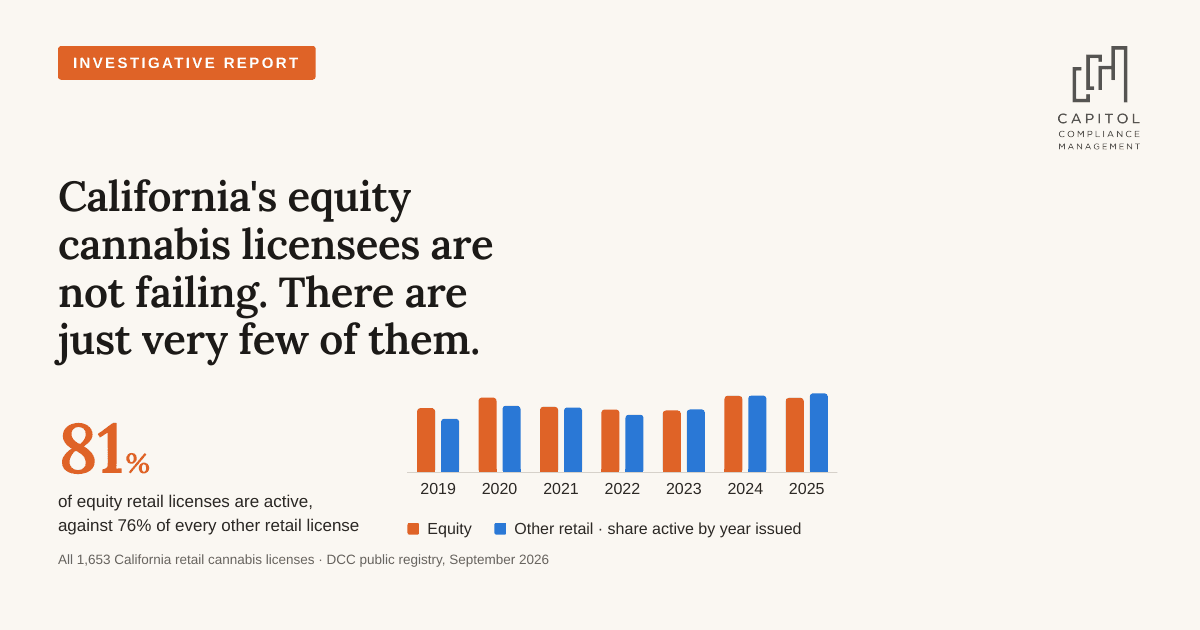
The main finding deserves attention: 81% of licenses carrying the state’s equity label were active, compared with 76% of licenses without that label. The equity group also had a higher active share in each year from 2019 through 2022. That is a useful finding. It gives us a reason to question the idea that equity retailers are less likely to stay licensed. Still, an active license tells only part of a business’s story. It does not tell us whether the shop earns a profit, whether its doors are open, or whether its first owner remains in charge.
The records also show where equity-labeled licenses are found, how they connect to other licenses, and when renewals are due. Taken together, they offer a clearer view of this part of California’s cannabis market—and show where better information is needed.
What we counted
The California Department of Cannabis Control, or DCC, keeps a public list of cannabis licenses. Each record includes details such as the license number, business name, location, issue date and current status. Some businesses have the words “[Equity Retailer]” added to their names. We used that label to identify the equity group in this study.
Our data was collected on September 25, 2026. It included 1,653 storefront retail licenses in all listed statuses, rather than active licenses alone. Of those, 281 carried the equity label. The other 1,372 did not. Including inactive records matters. Looking only at active licenses would leave out those that expired, were revoked, or otherwise stopped being active.
The label also has limits. A business may take part in a local equity program without having the label in its state record. For that reason, we refer to licenses “with the equity label” and licenses “without the label.” We cannot assume the second group contains no equity businesses. This is a study of the licenses we could identify from public records. It is not a full count of every equity business in California.
Older licenses help put the finding in context
Across the full study, 229 of the 281 equity-labeled licenses were active. That is about 81%. Among licenses without the label, 1,036 of 1,372 were active, or about 76%. But comparing those two totals is only a starting point. A license issued last year has had less time to expire than one issued seven years ago. In our data, licenses with the equity label were younger on average. A simple comparison could make them look stronger partly because they had less time to become inactive. To address that issue, we compared licenses issued in the same year.
| Year first issued | With equity label, still active | Without equity label, still active |
|---|---|---|
| 2019 | 41 of 52 — 79% | 369 of 559 — 66% |
| 2020 | 11 of 12 — 92% | 67 of 82 — 82% |
| 2021 | 29 of 36 — 81% | 82 of 103 — 80% |
| 2022 | 44 of 56 — 79% | 156 of 221 — 71% |
| 2023 | 54 of 71 — 76% | 106 of 137 — 77% |
| 2024 | 15 of 16 — 94% | 83 of 88 — 94% |
| 2025 | 32 of 35 — 91% | 94 of 97 — 97% |
The equity group had a higher active share in each of the four years from 2019 through 2022. The largest gap was in 2019: 79% compared with 66%. The pattern changed in more recent years. In 2023, the equity group was slightly lower. In 2024, both groups rounded to 94%. In 2025, the group without the label was higher. These details matter. They keep us from turning a useful finding into a claim that applies to every year or every business.
When we combined the licenses issued from 2019 through 2022, about 80% of the equity group and 70% of the other group were active. That combined figure is a summary. The year-by-year results above give readers a better view of how the comparison changes. The report also checked whether Los Angeles County alone explained the older-license result. With Los Angeles removed, the combined figures were about 77% and 70%. The difference remained.
The reasonable conclusion is that the older equity-labeled licenses in this study often remained active at a higher rate. The records do not support treating these licenses as more likely to lapse simply because they carry an equity label.
Staying licensed is one measure of progress
Keeping a license active is an important part of running a legal cannabis business. Without the needed license, an operator cannot lawfully carry out the work it covers. But a license record is not a business health report. It does not show sales, rent, debt, wages or profit. It does not tell us how much money the owner has put into the business. Nor does it show whether the people the equity program was meant to help still receive its benefits.
A shop could hold an active license while facing serious money problems. A license could also remain active after a change in ownership. The same care is needed when reading inactive records. An expired or surrendered license does not, by itself, explain what happened to the business. We would need more information to know whether the shop closed, moved, changed its license, or continued under another operator.
Our finding concerns license status on one date. It is evidence about staying licensed, not proof of financial success. That narrower finding still matters. It gives business owners, public officials and others a better basis for discussing equity retailers. Questions about a particular business should be answered with facts about that business, rather than assumptions about its equity status.
More than half of the labeled licenses are in Los Angeles County
The equity label appeared on about 17% of the storefront retail licenses in our study. Those licenses were spread unevenly across California.
| County | Licenses with the equity label |
|---|---|
| Los Angeles | 156 |
| Sacramento | 26 |
| San Francisco | 19 |
| Sonoma | 11 |
| Humboldt | 9 |
| Riverside | 6 |
| Alameda | 5 |
| All other counties combined | 49 |
| Total | 281 |
Los Angeles County held 156 of the 281 labeled licenses—more than half. The other counties together held 125. This tells us where the state’s labeled storefront licenses are found. It does not tell us why the pattern exists. We did not measure how many people applied in each county, how many received local approval, or how many gave up before receiving a state license. We also did not compare these counts with each county’s population or total number of cannabis shops. Those would be useful next steps before drawing conclusions about access.
There is another counting issue: one address can have more than one license. The 281 equity-labeled licenses were linked to 255 distinct addresses. In Sacramento County, 26 licenses were linked to 16 addresses. So “281 licenses” does not mean “281 separate businesses” or “281 open shops.” The unit being counted should always be clear.
Most business groups were linked to one location
We also explored how licenses connected to one another. For this part of the study, we used a wider set of records covering storefront retail, delivery and microbusiness licenses. A microbusiness license can cover several types of cannabis activity. We grouped records using shared company names, business names and addresses. This helped us look for businesses with licenses at more than one location.
Under those rules, 209 groups had an equity-labeled license as their earliest license record. Of those, 196 were linked to one location—about 94%. The other 13 were linked to more than one. That sounds like a striking limit on growth. But it needs a fair comparison.
The same table identified 2,119 groups whose earliest license did not carry the equity label. Of those, 2,008 were in the single-location category—about 95%. In other words, being linked to one location was common in both groups. These figures alone do not show that equity businesses face a greater barrier to opening a second site.
The records did identify 24 groups whose earliest license lacked the label but whose later licenses included it. Together, those groups were linked to 244 locations. That is an interesting difference in scale, and it raises questions worth studying. Still, these counts include inactive licenses. They describe locations found in the records, not a confirmed count of shops operating today. They also do not measure business growth through higher sales, added staff or new products at one site.
The useful finding is that most groups in both categories were linked to one location, while some larger groups also held equity-labeled licenses. More evidence is needed to explain what those connections mean.
A shared name does not tell us who owns the business
The state’s equity label is attached to a license record. It is not a full account of ownership. Using our matching rules, 58 of the 281 equity-labeled storefront licenses were linked to groups that also included licenses without the label. That is about one in five. Among licenses issued from 2019 through 2022, about 79% of the labeled licenses with these links were active. About 80% of those without such links were active. The older-license finding appeared in both sets.
But shared names and addresses are clues, not proof of common control. Two businesses may use the same brand without having the same owners. An address may appear in the records of two operators who used the site at different times. A business with no clear links in the registry may still have outside investors.
The records we used did not provide a full history of ownership changes or private agreements. They also did not show whether the equity label was present when a license was first issued. We therefore cannot use these links to claim that larger companies took control from equity owners, or that businesses without links are fully independent. Answering those questions would require more than the public license list.
Sacramento shows why one list is not enough
The City of Sacramento runs the Cannabis Opportunity Reinvestment and Equity program, known as CORE. Its public participant list offers another way to identify local equity businesses. We compared that list with the state records. Among the seven storefront participants we matched, six had the state equity label and one did not. Among eight matched delivery-only participants, none had the label. One participant could not be matched with enough confidence and was left out of the comparison.
This shows that using the state label alone can miss businesses listed in a local equity program. It also shows why the type of business matters: a study of labeled storefront licenses cannot describe every delivery business or every other part of the equity market.
We found differences when looking from the state list back to CORE, too. But the state count covered Sacramento County, while CORE is a City of Sacramento program. Those are different areas. A county location’s absence from the city list is not enough to show a conflict in its status. The lists may also differ in their purpose, update dates or business names.
For operators, the practical step is to confirm their status and obligations with the agencies involved. For researchers, it is to explain which list they used and who may be missing.
Renewal dates offer a clear planning lesson
The license records also point to a busy period for renewals. Of the 1,265 active storefront retail licenses in the study, 717 had expiration dates from April through July 2027. That is about 57%. June alone accounted for 299 licenses. For licenses with the equity label, 144 of 229—about 63%—fell in that four-month period. For licenses without the label, the figure was 573 of 1,036, or about 55%.
These are dates recorded in September 2026. They are useful for planning, but they do not predict which licenses will lapse or how long an agency will take to review a renewal. Operators can use the time before their deadline to review the records that support their business:
- Check that written procedures match how the business works today.
- Review inventory records and resolve differences with the state’s tracking system.
- Keep staff training records current.
- Confirm local permit deadlines and conditions alongside state requirements.
These are practical compliance steps, rather than causes of license loss proved by this study. If several licenses belong to one business, track each one. If several businesses share a site or brand, make clear who is responsible for each filing. Use the actual deadlines for the licenses and permits involved.
What we still need to learn
The public records provide a useful starting point. They leave important questions open. We cannot count every equity business from the state label. We cannot measure profit or fully trace ownership. We cannot treat every address linked to an old license as a current shop.
The records also lack the dates when licenses changed status, so they do not show how long each inactive license lasted. Earlier temporary licenses are not fully represented. Businesses that never reached state licensing are outside this study. The active-license finding does not tell us how many businesses first used a provisional license and later moved to an annual one. That would require a separate review of their license histories.
Better information would help answer the larger questions: who gets into the market, who stays in control, who earns a living, and who benefits from public support. For now, the strongest finding is clear. Many older retail licenses carrying the state’s equity label remained active, and their active share was higher than that of other licenses issued in the same years from 2019 through 2022.
That deserves a place in the discussion of California’s equity programs. It supports a more informed view of these retailers while leaving room to examine the challenges the license records cannot show.
Report and data requests
Journalists and researchers can request the report and the underlying extract of 1,653 storefront retail license records at compliance@ccmup.com. The report also describes the separate analysis of links among retail, delivery and microbusiness licenses.
Capitol Compliance Management is a Sacramento-based cannabis compliance consultancy serving California operators. CCM helps businesses obtain licenses, maintain compliance and address regulatory problems. CCM is not a law firm; on enforcement matters, it works alongside the operator’s cannabis attorney.
Disclosure: CCM works with California cannabis operators, including equity license holders. The author is listed in the public registry as an owner on two equity-labeled licenses included in the study. Both were issued in 2023, so they are outside the 2019–2022 comparison discussed here.